
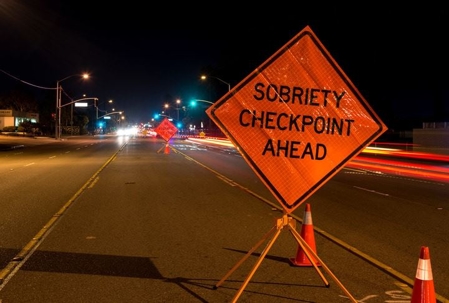
Under normal circumstances, a police officer needs probable cause to stop and detain a motorist — usually by observing a traffic violation, signs of impaired driving, or receiving a tip.
DUI checkpoints are one of the few exceptions to that rule.
The United States Supreme Court addressed this issue in the landmark case Michigan Department of State Police v. Sitz. In that case, the Court held that sobriety checkpoints do not require the same probable cause as a typical traffic stop. The reasoning was that the brief intrusion into a motorist’s privacy is outweighed by the government’s substantial interest in keeping drunk drivers off the road.
California courts have agreed, but with important limitations.
Why DUI Checkpoints Are Constitutional in California
In California, the controlling case is Ingersoll v. Palmer. There, the California Supreme Court held that sobriety checkpoints are not traditional criminal investigations, but rather “administrative procedures,” similar to airport screenings or agricultural checkpoints. Because of that classification, checkpoints are permitted, but only if they are conducted in a way that minimizes intrusion and limits officer discretion.
To ensure constitutionality, the Court laid out specific factors that law enforcement must follow:
- The decision to conduct a checkpoint must be made at the supervisory level, not by officers in the field.
- Officers must use a neutral formula to decide which vehicles are stopped (for example, every third car), rather than exercising individual discretion.
- The checkpoint must be conducted safely, with proper lighting, warning signs, and traffic controls.
- The checkpoint must be clearly visible to oncoming motorists.
- The location must be reasonable and chosen because it is likely to result in DUI arrests.
- The time and duration of the checkpoint should minimize intrusiveness while maximizing effectiveness.
- Motorists may only be detained briefly — just long enough for officers to ask basic questions and look for signs of intoxication.
- Law enforcement should publicize the checkpoint in advance to reduce intrusiveness and enhance its deterrent effect. While advance publicity is not strictly required, the California Supreme Court later noted in People v. Banks that it is strongly favored.
These requirements exist to prevent checkpoints from becoming arbitrary or overly invasive.
Do You Have to Stop at a DUI Checkpoint?
If you drive up to a properly conducted DUI checkpoint in California, yes — you must stop. This is one of the limited situations where law enforcement can briefly detain you without individualized probable cause.
That said, the law does not require you to drive through a checkpoint in the first place.
Is It Legal to Avoid a DUI Checkpoint?
Yes, there is no law requiring you to enter a DUI checkpoint. In fact, one of the constitutional requirements of checkpoints is that they be visible enough to allow motorists to turn away before reaching them.
The California Supreme Court specifically addressed this in Ingersoll, stating:
“A sign announcing the checkpoint was posted sufficiently in advance of the checkpoint location to permit motorists to turn aside, and under the operational guidelines no motorist was to be stopped merely for choosing to avoid the checkpoint.”
In practical terms, that means two things:
- You may legally avoid a checkpoint by turning off before you reach it.
- You may also avoid checkpoints altogether by checking published checkpoint locations, which are often announced in advance.
The Catch: Avoiding a Checkpoint Must Be Done Legally
While avoiding a checkpoint is legal, doing so illegally is not.
Law enforcement officers are well aware that motorists may try to avoid checkpoints, and officers are often positioned nearby specifically to watch for traffic violations. Avoiding the checkpoint alone does not give an officer probable cause to stop you. However, committing a traffic violation does.
An illegal U-turn, improper lane change, speeding, or even a malfunctioning brake light can give an officer lawful grounds to pull you over. It does not matter that the officer’s real interest may be investigating for DUI; as long as there is independent probable cause for the traffic stop, the stop is legal.
Once stopped, the officer will be looking closely for so-called “objective symptoms of intoxication,” such as bloodshot eyes, slurred speech, or the smell of alcohol.
The Bottom Line
DUI checkpoints are a constitutional exception to the normal probable cause requirement, but only when they follow strict guidelines.
If you pull up to a checkpoint, you must stop. However, you are legally allowed to avoid a checkpoint as long as you do so safely and without violating any traffic laws.
If you choose to turn away, do it carefully. Law enforcement will be watching, and even a minor mistake can provide the justification for a stop that opens the door to a DUI investigation.
Arrested at a DUI Checkpoint? Call Us for Help
DUI checkpoint cases often look simple on the surface, but they can involve complex constitutional issues. Whether a checkpoint was properly set up, whether officers followed the required guidelines, and whether a stop or detention went beyond what the law allows are all questions that can make or break a case.
Small violations of these rules can lead to suppressed evidence — and in some cases, dismissed charges.
At The Law Offices of Taylor & Taylor, we have been defending DUI cases since 1979 and were the first firm in California to focus exclusively on DUI defense. Our attorneys have decades of experience analyzing the legality of DUI checkpoints, identifying improper stops, and challenging arrests that stem from unconstitutional procedures.
Because DUI checkpoints are governed by strict rules, they are particularly vulnerable to legal challenges when law enforcement cuts corners. We carefully examine how a checkpoint was planned, whether officers limited their discretion, how long motorists were detained, and whether any alleged violations occurred after an unlawful stop.
If you were stopped or arrested at a DUI checkpoint, or after attempting to legally avoid one, having a law firm that understands the constitutional limits of checkpoint enforcement can make a critical difference.
Call (562) 330-4173 to discuss your case in a free consultation.